Defense &
Early Rocketry
Defense &Early Rocketry

Browse by mission, era, or program

A-7 Corsair II

The machine behind the mission

A-7 Corsair II

  • First flight 1965
  • US Navy carrier attack jet
  • Served until 1991

A compact Navy attack jet flown off carrier decks from Vietnam to Desert Storm. Pilots nicknamed it the “SLUF,” and it was one of the first jets to put a modern heads-up display in front of the pilot.

Shop the Defense shirts

WARFARE

Rocketry's first customers were armies. Missiles built for deterrence — Redstone, Atlas, Titan — carried megaton stakes before they ever carried science. The road to orbit runs straight through the arsenal.

BUILT STUBBORN

The Space Age wasn't born confident — it was born stubborn…

SHOP Defense & Early Rocketry COLLECTION

SHOWING 3 OUT OF 3 PRODUCTS
ABMA - The Mercury-Redstone Project

Early rocketry, by the numbers

Fig 18NASA TM X-53107
Redstone family
83.38 FTMERCURY-REDSTONE

One missile, three jobs: the Army Redstone, stretched into Jupiter-C, then topped with a man.

Redstone family

Fig 1JPL PUB. 145
Explorer 1 cutaway
30.66 LBEXPLORER 1 - 31 JAN 1958
LC-26A - 10:48 pm

The first American satellite was a stovepipe: 80 inches long, six and a quarter across.

Explorer 1 cutaway

Fig 19NASA TM X-53107
MR-3 flight plan
11 GPEAK LOAD - MR-3

Fifteen minutes, start to splash: 116 miles up, 302 miles downrange, 5,134 mph.

MR-3 flight plan

First launch from the Cape
BUMPER 8
A V-2 with a WAC Corporal on top
24 JUL 1950
LC-3 - CAPE CANAVERAL
1946V-2s rise
White Sands
24 Jul 1950Bumper 8
first from the Cape
31 Jan 1958Explorer 1
answers Sputnik
ABMA - RANGE DATA
Checked - Max Q
Brush Mark 200 - 25 mm/minT-00:00 - T+15:22CH 2 - CHAMBER PRESS - CH 5 - ACCEL
DID YOU KNOW?
AIR FORCE MISSILE TEST CENTER
PATRICK AIR FORCE BASE, FLORIDA

LAUNCH LOG - CAPE CANAVERAL

LAUNCH COMPLEXES 1 THROUGH 34 - THE EASTERN TEST RANGE - BUMPER TO MERCURY
FINAL - 1950 TO 1961

Before the Cape was NASA's, it was the Air Force's missile range: a sandy point where the Army, Navy and Air Force fired everything they had out over the Atlantic. This is the log of that decade, pad by pad.

PREPARED BY
RANGE OPERATIONS
AIR FORCE MISSILE TEST CENTER
REPRINTED FOR CAPE KENNEDY CLOTHING
Artie RedstoneRange Safety Officer
Max QTest Conductor
Turn the page →
AFMTC

FIG 18CONFIGURATION COMPARISON OF REDSTONE VEHICLES

ETR
CONFIGURATION COMPARISON OF REDSTONE VEHICLES
Tap the drawing to enlarge

One missile, three jobs. The Army Redstone was built at Huntsville to throw a warhead 200 miles. Stretched and topped with spinning solid stages it became the Jupiter-C that put Explorer 1 up from the Cape in January 1958. Stretched again, with a capsule and escape tower, it put Alan Shepard into space from Pad 5 in May 1961.

  1. 1Redstone - 69.48 feet, the ballistic missile. First flown from Cape Canaveral in August 1953.
  2. 2Jupiter-C - 69.90 feet, a Redstone with longer tanks and a tub of small solid rockets spinning on top. Explorer 1 was the fourth stage.
  3. 3Mercury-Redstone - 83.38 feet with the capsule and escape tower. Tanks stretched 6 feet for 20 more seconds of burn.
  4. 4The tank section, 37.50 feet on the stretched versions against 32.08 on the missile.
Heights
Redstone69.48 ft
Jupiter-C69.90 ft
Mercury-Redstone83.38 ft
Diameter70 in
EngineRocketdyne A-7, 78,000 lb
Propellantsalcohol and LOX

Source: The Mercury-Redstone Project, NASA TM X-53107, MSFC, December 1964 (and MR-3 flight plan, Figure 19).

MissionCAPE CANAVERAL
EditionFINAL
Date1950 - 1961
Time1953 - 1961
Day/Rev-
PageLOG-5
AFMTC Form 29PATRICK AIR FORCE BASE, FLORIDA
AFMTC

DID YOU KNOW?RANGE LOG

ETR

Fruit Flies First

The first living things sent to space rode a V-2 in 1947 — fruit flies, parachuted home alive before any monkey or man.

V-2 from White Sands, before the Cape

Ten-Foot Walls

Early launch crews watched from concrete blockhouses just yards from the pad — with domed roofs up to eight feet thick.

Eight feet of concrete overhead, two periscopes

Missile Row

By 1960 Cape Canaveral's shoreline was so crowded with launch pads that the strip earned a nickname: "Missile Row".

Missile Row, LC-11 to LC-20
MissionCAPE CANAVERAL
EditionFINAL
Date1950 - 1961
Time
Day/Rev-
PageLOG-1
AFMTC Form 29PATRICK AIR FORCE BASE, FLORIDA
AFMTC

FIG 1CUTAWAY VIEWS - EXPLORER I AND EXPLORER III

ETR
CUTAWAY VIEWS - EXPLORER I AND EXPLORER III
Tap the drawing to enlarge

The first American satellite was a stovepipe: 80 inches long, six and a quarter across, 30 pounds with its burned-out fourth-stage motor still attached. Van Allen's Geiger counter rode in the nose, and it kept going quiet at the top of the orbit. Explorer III, with a tape recorder, showed why: the counter was saturating in a belt of radiation nobody knew was there.

  1. 1Cosmic ray and micrometeorite package - James Van Allen's Geiger counter and the microphone that listened for dust.
  2. 2Turnstile antenna - four whip wires held out by the spin, for the low-power transmitter.
  3. 3Explorer III - launched March 26, 1958, with a tape recorder that stored a whole orbit and played it back over a station.
  4. 4The fourth-stage motor, a scaled-down Sergeant, stayed on. The satellite was the top of the rocket.
Explorer I
Length80.75 in
Diameter6.25 in
Mass30.66 lb
Launch31 Jan 1958, 10:48 pm EST
PadLC-26A, Cape Canaveral
Orbit224 x 1,575 mi
Transmitters60 mW and 10 mW

Source: The Explorer Rocket Research Program, JPL Publication No. 145, 1958.

MissionCAPE CANAVERAL
EditionFINAL
Date1950 - 1961
Time31 JAN 1958
Day/Rev-
PageLOG-6
AFMTC Form 29PATRICK AIR FORCE BASE, FLORIDA
AFMTC

Section VILAUNCH LOG - FIRSTS

ETR

Fourteen entries from the first decade, with the pad each one left from.

VehicleDatePadResultEvent
Bumper 8 24 Jul 1950 LC-3 Partial The first launch from Cape Canaveral - a V-2 with a WAC Corporal on top
Redstone RS-1 20 Aug 1953 LC-4 Partial First flight of the Army's Redstone - the missile that would carry Mercury
Jupiter-C RTV 20 Sep 1956 LC-5 Success 682 miles up, 3,335 miles downrange - a satellite in all but name
Thor 101 25 Jan 1957 LC-17B Failure First Thor; it rose a few inches and fell back onto the pad
Atlas 4A 11 Jun 1957 LC-14 Failure First Atlas flight - lost thrust at 26 seconds and was destroyed by range safety at 50
Vanguard TV-3 6 Dec 1957 LC-18A Failure The first U.S. satellite attempt, on live TV; it rose four feet and exploded
Juno I - Explorer 1 31 Jan 1958 LC-26A Success America's first satellite; discovered the Van Allen belts
Thor-Able - Pioneer 1 11 Oct 1958 LC-17A Partial The first launch under NASA, eleven days old; it reached 70,700 miles
Titan I 6 Feb 1959 LC-15 Success First Titan, first flight on the first try
Jupiter AM-18 28 May 1959 LC-26B Success Able and Baker ride a nose cone 300 miles up and come home alive
Mercury-Redstone 2 31 Jan 1961 LC-5 Success Ham the chimpanzee; the last test before a man
Minuteman I 1 Feb 1961 LC-31 Success First all-up solid-fuel ICBM, perfect on the first try
Mercury-Redstone 3 5 May 1961 LC-5 Success Alan Shepard, Freedom 7 - the first American in space
Atlas 109-D - MA-6 20 Feb 1962 LC-14 Success John Glenn, three orbits - the Cape becomes the Space Coast

LC-5, LC-6 and LC-26 are preserved by the Air Force Space and Missile Museum at Cape Canaveral Space Force Station. The blockhouse at LC-26 still has its periscopes.

MissionCAPE CANAVERAL
EditionFINAL
Date1950 - 1961
Time1950 - 1961
Day/Rev-
PageLOG-2
AFMTC Form 29PATRICK AIR FORCE BASE, FLORIDA
AFMTC

FIG 17MERCURY-REDSTONE SPACECRAFT AND BOOSTER

ETR
MERCURY-REDSTONE SPACECRAFT AND BOOSTER
Tap the drawing to enlarge

Every dimension in inches, the way the drawing office wrote it. From the fin tips to the top of the escape tower, 996 inches: 83 feet. The booster is a little under 60 feet of it; the spacecraft and tower the rest. The 70-inch diameter was the Redstone's, so the capsule had an adapter to sit on.

  1. 1Spacecraft and tower - 254.80 inches from the adapter joint to the top of the tower, plus 31 for the escape-rocket nozzle.
  2. 2Adapter - the 147.08-inch section that mated the 74.5-inch capsule to the 70-inch booster.
  3. 3Booster - 70 inches across, 710.27 inches from the fins to the adapter joint. Alcohol forward, liquid oxygen aft.
  4. 4Fins - 152 inches across. Redstone steered with carbon vanes in the exhaust and air rudders on the fins.
Stack
Overall996.07 in (83 ft)
Fins to adapter joint710.27 in
Spacecraft and tower254.80 in
Booster diameter70 in
Fin span152 in
Lift-off weightapprox 66,000 lb

Source: The Mercury-Redstone Project, NASA TM X-53107, MSFC, December 1964 (and MR-3 flight plan, Figure 19).

MissionCAPE CANAVERAL
EditionFINAL
Date1950 - 1961
TimePAD 5
Day/Rev-
PageLOG-7
AFMTC Form 29PATRICK AIR FORCE BASE, FLORIDA
AFMTC

FIG 19MERCURY-REDSTONE FLIGHT PLAN

ETR
MERCURY-REDSTONE FLIGHT PLAN
Tap the drawing to enlarge

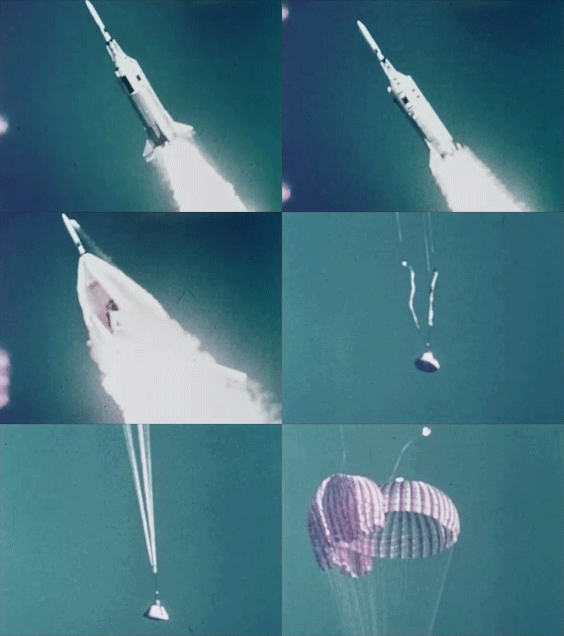
Fifteen minutes, start to splash. Engine cutoff at 2 minutes 22 seconds, tower off, capsule off, turnaround, then five minutes of weightlessness over the top at about 100 nautical miles. Retrofire at 5 minutes 14 seconds was not needed on a ballistic hop; Shepard fired the retros anyway, for practice. Eleven g on the way down.

  1. 1Apogee - about 100 nautical miles, 116 statute. Shepard reached 116.5.
  2. 202:22 cutoff, tower jettison, then capsule separation at 02:32 and the periscope out.
  3. 3Retrofire - three solid retrorockets at five-second intervals, then the retropack jettisoned a minute later.
  4. 4Drogue at 21,000 feet, main chute at 10,000, splashdown about 263 nautical miles downrange.
MR-3, 5 May 1961
Cutoff02:22
Apogee116.5 statute mi
Max speed5,134 mph
Weightlessapprox 5 min
Peak load11 g
Range302 statute mi
Flight time15 min 22 s

Source: The Mercury-Redstone Project, NASA TM X-53107, MSFC, December 1964 (and MR-3 flight plan, Figure 19).

MissionCAPE CANAVERAL
EditionFINAL
Date1950 - 1961
Time00:00 - 15:22
Day/Rev-
PageLOG-8
AFMTC Form 29PATRICK AIR FORCE BASE, FLORIDA
AFMTC

Section IVLC-26 COUNTDOWN - EXPLORER 1

ETR

Juno I, January 31, 1958 - the first American satellite

Tick through the night from the blockhouse at Launch Complex 26A.

Tap a box to check it off

Items complete 0/8BIRD AWAY
MissionCAPE CANAVERAL
EditionFINAL
Date1950 - 1961
TimeT-? - 2:00 AM
Day/Rev-
PageLOG-3
AFMTC Form 29PATRICK AIR FORCE BASE, FLORIDA
AFMTC

FIG 34CHART OF RECOVERY OPERATIONS

ETR
CHART OF RECOVERY OPERATIONS
Tap the drawing to enlarge

The whole flight fit on one chart of the Bahamas. A carrier sat at the predicted landing point, destroyers and helicopters were strung along the track in case it came down short, and the Cape was in the top left corner. For MR-3 the carrier was the USS Lake Champlain, and the helicopter had Shepard on deck eleven minutes after splash.

  1. 1Cape Canaveral - Pad 5, with the blockhouse a few hundred feet from the rocket.
  2. 2Predicted landing point - the capsule drifted a few miles from it under the chute.
  3. 3Carrier - the USS Lake Champlain for Shepard, with the recovery helicopters aboard.
  4. 4A/C-4 and A/C-5 - helicopters on station downrange, with destroyers DD-1 through DD-4 on the line.
MR-3 Recovery
CarrierUSS Lake Champlain
Splashdown302 mi downrange
Helicopter on deck11 min after splash
CapsuleFreedom 7
PilotAlan B. Shepard Jr.

Source: The Mercury-Redstone Project, NASA TM X-53107, MSFC, December 1964 (and MR-3 flight plan, Figure 19).

MissionCAPE CANAVERAL
EditionFINAL
Date1950 - 1961
Time15:22
Day/Rev-
PageLOG-9
AFMTC Form 29PATRICK AIR FORCE BASE, FLORIDA
AFMTC

Section IRANGE TERMS

ETR
AFMTCAir Force Missile Test Center - ran the Cape from 1951 (the Long Range Proving Ground before that)
ETREastern Test Range - the Cape and the downrange tracking stations to Ascension Island
LCLaunch Complex - numbered 1 to 46 along the shore; 26 and 5/6 are museum pads
BlockhouseThe reinforced concrete control room beside each pad - LC-26's has 2-foot walls and a roof nearly 8 feet thick and periscopes
RSORange Safety Officer - held the destruct button for every launch
LOXLiquid oxygen - the oxidizer, loaded cold in the last hours
IRBMIntermediate Range Ballistic Missile - Thor and Jupiter, 1,500 miles
ICBMIntercontinental Ballistic Missile - Atlas, Titan, Minuteman
Juno IThe Jupiter-C with a live fourth stage - the Explorer 1 launcher
Missile RowThe line of pads along the beach from LC-11 to LC-20 - all firing by 1960
Bird awayRange slang for a successful liftoff
Space CoastBrevard County, Florida - the name arrived with Mercury
MissionCAPE CANAVERAL
EditionFINAL
Date1950 - 1961
Time-
Day/Rev-
PageLOG-4
AFMTC Form 29PATRICK AIR FORCE BASE, FLORIDA