Space Shuttle & ISS
COLLECTION
Space Shuttle & ISSCOLLECTION

Browse by mission, era, or program

Space Shuttle

The machine behind the mission

Space Shuttle

  • 1981–2011
  • 135 missions
  • Launched from Pad 39A & 39B

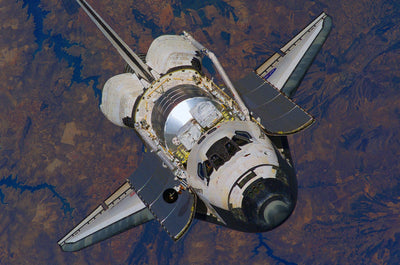
Orbiter, orange external tank and twin solid rocket boosters. The Shuttle was the winged spacecraft that launched like a rocket and glided home to a runway — flying from the Space Coast for 30 years and helping build the International Space Station.

Shop the Shuttle & ISS shirts

THE WORKHORSE ERA

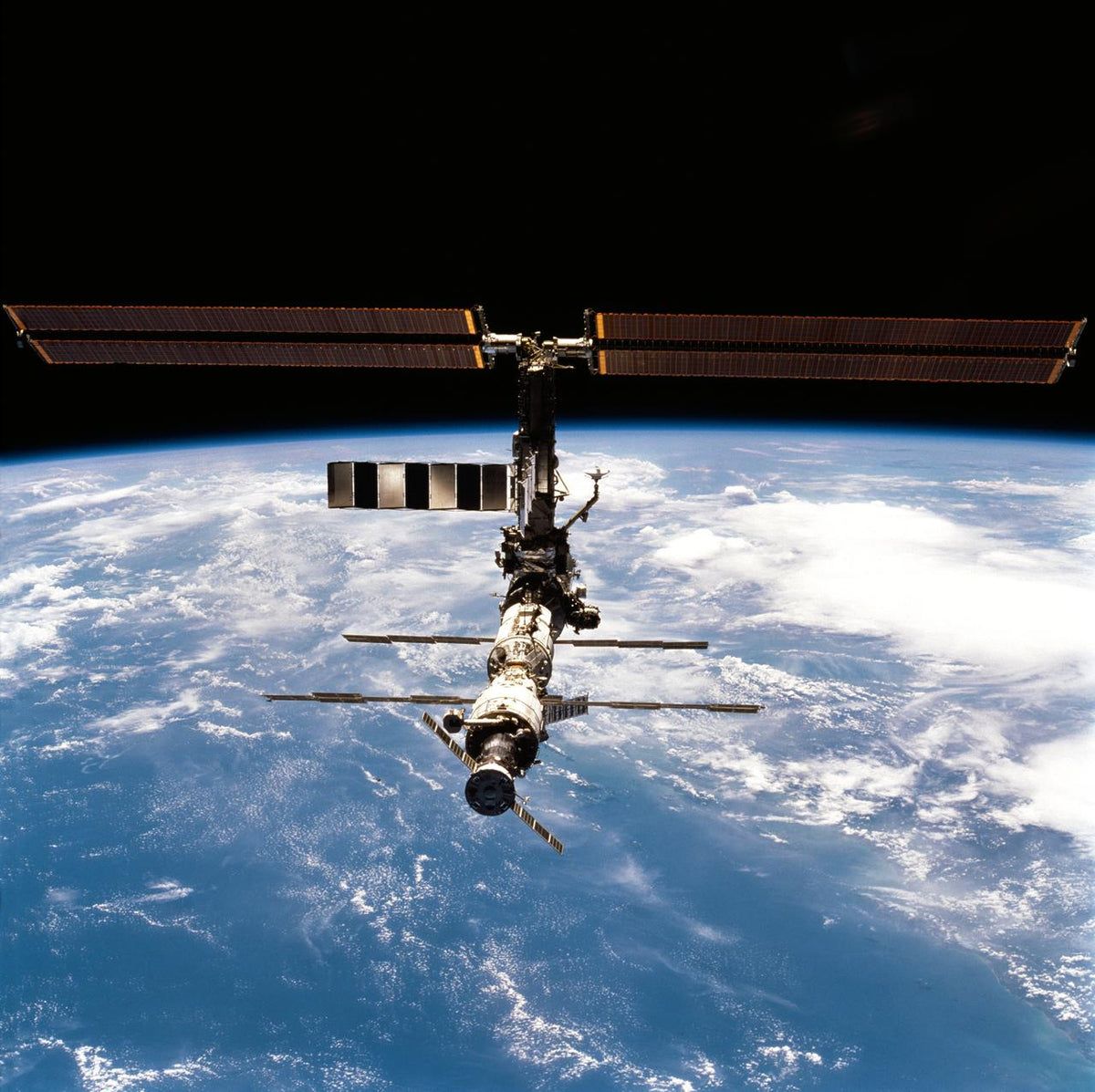
For thirty years the Shuttle launched like a rocket and landed like a glider — freeing Hubble, then assembling the ISS, crewed continuously since November 2000.

ORBIT AS A WORKPLACE

The Shuttle and station made orbit a workplace — a laboratory circling the world sixteen times a day. Our collection celebrates the era that made space routine.

SHOP Space Shuttle & ISS COLLECTION

SHOWING 2 OUT OF 2 PRODUCTS
Shuttle Crew Operations Manual - OI-21

Shuttle and Station, by the numbers

Fig 2.16-3SCOM 1.2
Space Shuttle Main Engine
470,000 LBTHRUST IN VACUUM - EACH

Fourteen feet tall and built to fly again: 65 to 109 percent on command, three per orbiter.

Space Shuttle Main Engine

Continuously crewed - ISS
25 YEARS
Since Expedition 1 arrived
2 NOV 2000 - TODAY
NASA - ROSCOSMOS - ESA - JAXA - CSA
Fig 1.2-8SCOM 1.2
Crew cabin
2,325 CU FTTHREE DECKS - 14.7 PSI
8 flown once - STS-61A

Sea-level pressure and ordinary air, ten flight-deck windows, a crew of up to seven.

Crew cabin

17,500 mphorbital velocity
MECO +8:30
24,000 tileseach one
hand inspected
60 ft baydoors open
by MET 01:30
STS - FLIGHT DATA
Checked - Max Q
Brush Mark 200 - 25 mm/minMET 00:00 - 02:00CH 1 - CABIN PRESS - CH 4 - SSME PC
DID YOU KNOW?
NATIONAL AERONAUTICS AND SPACE ADMINISTRATION
SPACE TRANSPORTATION SYSTEM

ASCENT AND ASSEMBLY TELEMETRY

STS-1 THROUGH STS-135 - 135 FLIGHTS - FIVE ORBITERS - AND THE STATION THEY BUILT
PRINTOUT - RUN 001

Thirty years of the same eight and a half minutes. This printout is the Shuttle as the flight controllers saw it - a column of times and events - and the station it carried up one piece at a time.

MISSION CONTROL CENTER
HOUSTON, TEXAS
REPRINTED FOR CAPE KENNEDY CLOTHING
Artie RedstoneFlight Director
Max QCAPCOM
Turn the page →
MCC-H FCR-1

FIG 1.2-8CREW CABIN - CUTAWAY VIEW

STS
CREW CABIN - CUTAWAY VIEW
Tap the drawing to enlarge

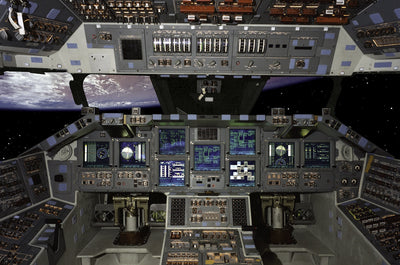
Three decks in a pressure vessel of 2,325 cubic feet, held at sea-level pressure, 14.7 psi, with ordinary air: 79 percent nitrogen, 21 percent oxygen. Flight deck on top, middeck below it, and under the middeck floor an equipment bay the crew could reach by lifting the panels.

  1. 1Flight deck - commander in the left seat, pilot in the right. Ten flight-deck windows: six forward, two overhead, two looking aft into the payload bay.
  2. 2Side hatch - 40 inches across. The way in on the pad and the way out after wheels stop.
  3. 3Avionics bays - three of them, holding the five general-purpose computers that flew the vehicle. Four ran the same software and voted.
  4. 4Airlock - 63 inches in diameter, room for two suited crew, with a hatch into the payload bay for spacewalks.
Crew Cabin
Pressurized volume2,325 cu ft
Cabin pressure14.7 psia
Decks3
Flight-deck windows10
Crewup to 7 (8 flown once, STS-61A)
Side hatch40 in diameter

Source: Shuttle Crew Operations Manual, SCOM 1.2 (OI-21), NASA Johnson Space Center, November 1992.

MissionSTS / ISS
EditionRUN 001
Date1981 - 2011
TimeT-0
Day/Rev-
Page0005
NASA JSC - MISSION OPERATIONSFLIGHT CONTROL ROOM 1
MCC-H FCR-1

DID YOU KNOW?ORBITER AND STATION NOTES

STS

The Glide Home

From orbit to wheels-stop, the returning orbiter was a 100-ton glider — one approach, no engines, no second chances.

Wheels stop, no second chance

Sixteen Sunrises

The station circles Earth every 90 minutes — crews watch a sunrise or sunset roughly every 45.

Sixteen orbits a day

Yesterday's Coffee

The ISS recycles about 98% of its water — yesterday's sweat and breath become tomorrow's coffee.

Water recovery on station
MissionSTS / ISS
EditionRUN 001
Date1981 - 2011
Time
Day/Rev-
Page0001
NASA JSC - MISSION OPERATIONSFLIGHT CONTROL ROOM 1
MCC-H FCR-1

FIG 1.3-1LIGHTWEIGHT EXTERNAL TANK

STS
LIGHTWEIGHT EXTERNAL TANK
Tap the drawing to enlarge

The biggest piece of the stack and the only one thrown away every flight. Two tanks and an intertank: liquid oxygen forward, liquid hydrogen aft. The orbiter rode on its back and drank from it for eight and a half minutes, then let it go to break up over the Indian or Pacific Ocean.

  1. 1Liquid oxygen tank - 143,351 gallons, 1,361,936 pounds. It sits forward on purpose, to keep the heavy end ahead of the center of pressure.
  2. 2Liquid hydrogen tank - 385,265 gallons but only 227,641 pounds. Hydrogen takes nearly three times the room for one-sixth the weight.
  3. 3Intertank - the solid rocket boosters bolted on here, so this ring carried the thrust of the whole stack.
  4. 4Aft attachment and umbilicals - the 17-inch feed lines that fed the three main engines.
External Tank
Length153.8 ft
Diameter27.6 ft
Gross lift-off weight1,655,577 lb
Inert weight66,000 lb
LOX143,351 gal
LH2385,265 gal
Burn rate at 104 pct64,957 gal/min

Source: Shuttle Crew Operations Manual, SCOM 1.2 (OI-21), NASA Johnson Space Center, November 1992.

MissionSTS / ISS
EditionRUN 001
Date1981 - 2011
TimeT+00:08:30
Day/Rev-
Page0006
NASA JSC - MISSION OPERATIONSFLIGHT CONTROL ROOM 1
MCC-H FCR-1

Section VIFLIGHTS OF RECORD

STS

Twelve of the 135, chosen because something changed on each one.

FlightDateOrbiter / CrewDurationEvent
STS-1 12 - 14 Apr 1981 Columbia - Young / Crippen 2d 06h First flight. Two men, no escape system, a vehicle that had never flown
STS-7 18 - 24 Jun 1983 Challenger - Crippen + 4 6d 02h Sally Ride, first American woman in space
STS-41G 5 - 13 Oct 1984 Challenger - crew of 7 8d 05h Kathryn Sullivan, first American woman to walk in space
STS-51L 28 Jan 1986 Challenger - crew of 7 73 sec Lost 73 seconds after liftoff. Scobee, Smith, Resnik, Onizuka, McNair, Jarvis, McAuliffe
STS-26 29 Sep - 3 Oct 1988 Discovery - Hauck + 4 4d 01h Return to flight
STS-31 24 - 29 Apr 1990 Discovery - Shriver + 4 5d 01h Hubble Space Telescope deployed
STS-71 27 Jun - 7 Jul 1995 Atlantis - Gibson + 6 9d 19h First docking with Mir - the first of nine
STS-95 29 Oct - 7 Nov 1998 Discovery - Brown + 6 8d 21h John Glenn flies again at 77
STS-88 4 - 15 Dec 1998 Endeavour - Cabana + 5 11d 19h Unity joined to Zarya - the first ISS assembly flight
STS-107 16 Jan - 1 Feb 2003 Columbia - crew of 7 15d 22h Lost on re-entry. Husband, McCool, Anderson, Brown, Chawla, Clark, Ramon
STS-114 26 Jul - 9 Aug 2005 Discovery - Collins + 6 13d 21h Return to flight; the first back-flip under the station for tile inspection
STS-135 8 - 21 Jul 2011 Atlantis - Ferguson + 3 12d 18h The last flight. Wheels stop at 5:57 a.m. EDT, July 21, 2011

Five orbiters flew: Columbia, Challenger, Discovery, Atlantis, Endeavour. Two were lost with their crews.

MissionSTS / ISS
EditionRUN 001
Date1981 - 2011
TimeSTS-1 - STS-135
Day/Rev-
Page0002
NASA JSC - MISSION OPERATIONSFLIGHT CONTROL ROOM 1
MCC-H FCR-1

FIG 2.16-3SPACE SHUTTLE MAIN ENGINE

STS
SPACE SHUTTLE MAIN ENGINE
Tap the drawing to enlarge

Fourteen feet tall, seven and a half feet across the bell, and reusable: the first big rocket engine built to fly again and again. Three of them burned liquid hydrogen and liquid oxygen at a six-to-one ratio. The crew could throttle them from 65 percent to 109 percent, and did, through the worst of the wind on the way up.

  1. 114 feet tall, about 7,000 pounds. Rated at 375,000 pounds of thrust at sea level and 470,000 in vacuum.
  2. 2Center engine, number 1. Each engine gimbaled 10.5 degrees in pitch and 8.5 in yaw to steer.
  3. 3Left engine, number 2.
  4. 4Right engine, number 3. Any one of the three could carry the ascent after the others shut down late.
SSME
Height14 ft
Nozzle diameter7.5 ft
Thrust, sea level375,000 lb
Thrust, vacuum470,000 lb
Throttle65 to 109 pct
Mixture6:1 LOX to LH2
Chamber pressureapprox 3,000 psi

Source: Shuttle Crew Operations Manual, SCOM 1.2 (OI-21), NASA Johnson Space Center, November 1992.

MissionSTS / ISS
EditionRUN 001
Date1981 - 2011
TimeT+00:00:06
Day/Rev-
Page0007
NASA JSC - MISSION OPERATIONSFLIGHT CONTROL ROOM 1
MCC-H FCR-1

FIG 2.9-1ENVIRONMENTAL CONTROL AND LIFE SUPPORT

STS
ENVIRONMENTAL CONTROL AND LIFE SUPPORT
Tap the drawing to enlarge

Where the air, the water and the heat went. Fuel cells made the electricity and, as a by-product, the drinking water. Freon loops picked up heat from the cabin and the electronics and carried it to whichever cooler could use it: radiators on orbit, a flash evaporator on the way up and down, an ammonia boiler on the runway.

  1. 1Fuel cell power plants - three of them, 7 kilowatts each, making water as they made power.
  2. 2Flash evaporator - cooled the vehicle by boiling water into space while the payload bay doors were shut.
  3. 3Radiators - mounted inside the payload bay doors, which is why the doors had to open soon after reaching orbit.
  4. 4Ammonia boiler - took over after landing, when there was no vacuum to boil water into.
  5. 5Cabin air heat exchanger - the cabin air loop, keeping the cabin near 70 degrees F.
ECLSS
Cabin pressure14.7 psia
Cabin gas79 pct N2 / 21 pct O2
Fuel cells3 x 7 kW
CoolantFreon-21, two loops
Heat rejection on orbitradiators
On ascent and entryflash evaporator
After landingammonia boiler

Source: Shuttle Crew Operations Manual, SCOM 1.2 (OI-21), NASA Johnson Space Center, November 1992.

MissionSTS / ISS
EditionRUN 001
Date1981 - 2011
TimeMET 01:30:00
Day/Rev-
Page0008
NASA JSC - MISSION OPERATIONSFLIGHT CONTROL ROOM 1
MCC-H FCR-1

Section IVISS ASSEMBLY SEQUENCE

STS

Stage by stage, 1998 - 2010

Tick off the station as it was built. Each line is one piece carried up and bolted on.

Tap a box to check it off

Items complete 0/10ASSEMBLY COMPLETE
MissionSTS / ISS
EditionRUN 001
Date1981 - 2011
Time1998 - 2010
Day/Rev-
Page0003
NASA JSC - MISSION OPERATIONSFLIGHT CONTROL ROOM 1
MCC-H FCR-1

FIG 2.9-25PAYLOAD BAY RADIATORS

STS
PAYLOAD BAY RADIATORS
Tap the drawing to enlarge

The payload bay doors did two jobs. They closed the 60-foot cargo bay, and their inside faces carried the radiators that kept the orbiter cool. Eight panels, each 10 by 15 feet. The forward four could tilt out 35.5 degrees to see more sky. If the doors would not open, the flight came home that day.

  1. 1Deployable forward radiators - tilted out to radiate from both faces.
  2. 2Fixed aft radiators - bonded to the door, radiating from one face.
  3. 3Payload bay - 60 feet long, 15 feet across. Hubble, the ISS modules and the lab modules all rode here.
  4. 4Remote manipulator system - the Canadian arm, carried on the port sill when the mission called for it.
Radiators
Panels8 (4 deployable, 4 fixed)
Panel size10 x 15 ft
Total areaapprox 1,200 sq ft
Deploy angle35.5 deg
Payload bay60 ft x 15 ft
Doors open byMET 01:30

Source: Shuttle Crew Operations Manual, SCOM 1.2 (OI-21), NASA Johnson Space Center, November 1992.

MissionSTS / ISS
EditionRUN 001
Date1981 - 2011
TimeMET 01:30:00
Day/Rev-
Page0009
NASA JSC - MISSION OPERATIONSFLIGHT CONTROL ROOM 1
MCC-H FCR-1

FIG 2.19-2REMOTE MANIPULATOR SYSTEM

STS
REMOTE MANIPULATOR SYSTEM
Tap the drawing to enlarge

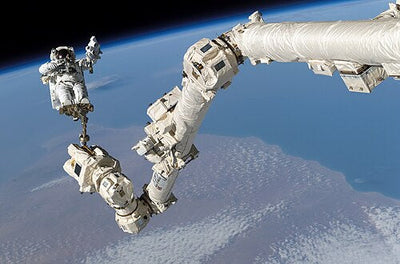
The Canadarm. Fifty feet three inches of graphite-epoxy boom with six joints, built by Spar Aerospace in Canada and first flown on STS-2 in November 1981. On orbit it could swing a 65,000-pound payload out of the bay. On the ground it could not lift its own weight.

  1. 1Shoulder - two joints, pitch and yaw, where the arm met the port sill.
  2. 2Elbow - one pitch joint between the upper and lower arm booms.
  3. 3Wrist - three joints, then the standard end effector, a snare that closed on a grapple fixture.
  4. 4Flown from the aft flight deck with a rotational hand controller and a translational hand controller, looking out the rear windows.
RMS
Length50 ft 3 in
Diameter15 in
Joints6
Weight905 lb
Payload handled on orbit65,000 lb
BuilderSpar Aerospace, Canada
First flightSTS-2, Nov 1981

Source: Shuttle Crew Operations Manual, SCOM 1.2 (OI-21), NASA Johnson Space Center, November 1992.

MissionSTS / ISS
EditionRUN 001
Date1981 - 2011
TimeMET 02:00:00
Day/Rev-
Page0010
NASA JSC - MISSION OPERATIONSFLIGHT CONTROL ROOM 1
MCC-H FCR-1

Section IACRONYMS - FLIGHT CONTROL

STS
SRBSolid Rocket Booster - two of them, 2.8 million pounds of thrust each, jettisoned at 2:04
SSMESpace Shuttle Main Engine - three on the orbiter, lit at T-6.6 seconds
ETExternal Tank - the orange one; the only part not reused
MECOMain Engine Cutoff - about 8 minutes 30 seconds, 17,500 mph
OMSOrbital Maneuvering System - the two engines that finished the climb and started the way down
RTLSReturn To Launch Site - the abort nobody ever wanted to fly
TALTransoceanic Abort Landing - the abort to a runway in Spain or Africa
TDRSTracking and Data Relay Satellite - how the orbiter talked to Houston nearly all the time
FCRFlight Control Room - where the flight director sat
EVAExtravehicular Activity - spacewalk; the station took some 160 to build and keep
ExpeditionA station crew increment; Expedition 1 arrived November 2, 2000
CAPCOMCapsule Communicator - the one voice to the crew, still an astronaut
MissionSTS / ISS
EditionRUN 001
Date1981 - 2011
Time-
Day/Rev-
Page0004
NASA JSC - MISSION OPERATIONSFLIGHT CONTROL ROOM 1