X-Planes & Experimental Flight
COLLECTION
X-Planes & Experimental FlightCOLLECTION

Browse by mission, era, or program

X-37B Orbital Test Vehicle

The machine behind the mission

X-37B Orbital Test Vehicle

  • First flight 2010
  • Uncrewed spaceplane
  • Missions of 900+ days

A robotic spaceplane that rides a rocket to orbit, stays up for years at a time, then flies itself home and lands on a runway — including the old Shuttle runway at Kennedy.

Shop the X-Planes shirts

FLYING QUESTION MARKS

Where dry lakebeds make runways miles long, America built aircraft to answer dangerous unknowns. The X-1 broke the sound barrier; the X-15 hit Mach 6.7, glowing from friction heat.

WHAT IF, AT MACH 6

Experimental flight is “what if?” asked at 700 mph and graded in telemetry. Our X-Planes collection is built for that mindset: fly the hypothesis.

SHOP X-Planes & Experimental Flight COLLECTION

SHOWING 2 OUT OF 2 PRODUCTS
NACA X-15 conference - October 1956

X-Planes, by the numbers

Fig 1NACA - X-15 CONF.
X-15 three-view, 1956 design
MACH 6.7FLIGHT 188 - 3 OCT 1967

Drawn three years before it flew. Design speed Mach 6; Pete Knight took it to 6.7.

X-15 three-view, 1956 design

Fig 6NACA - X-15 CONF.
Control regions
354,200 FTFLIGHT 91 - 22 AUG 1963
Walker - 67 mi up

Above about 100,000 feet the air is too thin for the tail; hydrogen peroxide thrusters take over.

Control regions

Fig 5NACA - X-15 CONF.
Ejection seat
0 OF 199TIMES THE SEAT WAS USED

Built to work at Mach 4 and 120,000 feet. In 199 flights, nobody ever pulled the handle.

Ejection seat

Sound barrier - Bell X-1
MACH 1.06
Yeager, Glamorous Glennis
14 OCT 1947
MUROC - CALIFORNIA
Mach 6.7Knight
Oct 1967
354,200 ftWalker
Aug 1963
199 flights1959 - 1968
12 pilots
X-15 - FLIGHT DATA
Checked - A. Redstone
Brush Mark 200 - 25 mm/minLAUNCH +00:00 - +10:30CH 1 - ALTITUDE - CH 4 - MACH
DID YOU KNOW?
NATIONAL AERONAUTICS AND SPACE ADMINISTRATION
FLIGHT RESEARCH CENTER - EDWARDS, CALIFORNIA

FLIGHT TEST SUMMARY - RESEARCH AIRPLANES

X-1 THROUGH X-15 - MUROC DRY LAKE AND EDWARDS AIR FORCE BASE - WITH THE LIFTING BODIES AND THE SCRAMJET THAT FOLLOWED
COMPILED 1947 - 2004

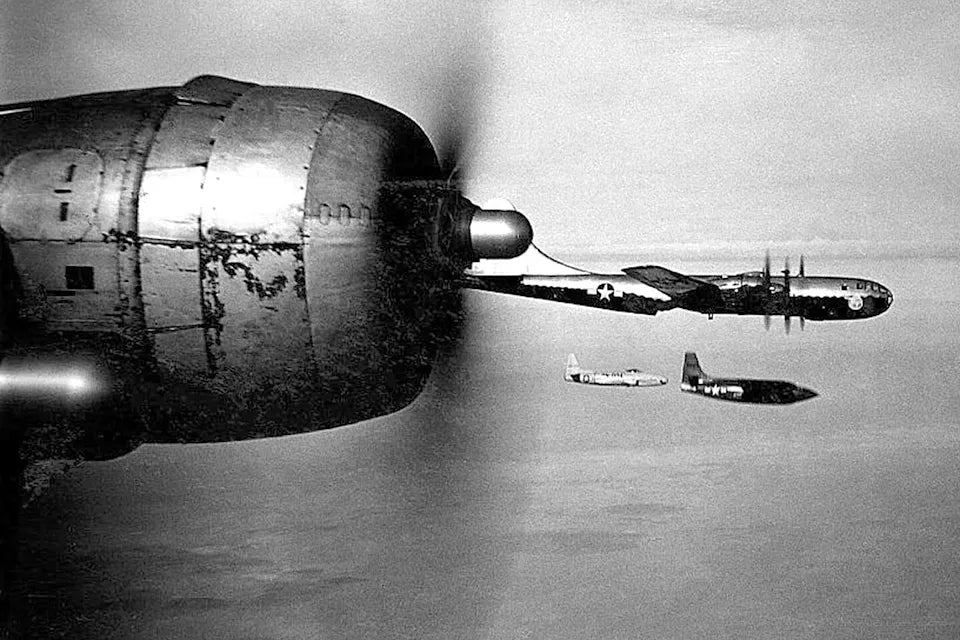
Before anyone rode a rocket, they strapped one to an airplane and dropped it from a bomber over the Mojave. These are the flights that found the edge of the air - and the pilots who flew past it.

PREPARED BY
FLIGHT RESEARCH CENTER
REPRINTED FOR CAPE KENNEDY CLOTHING
Artie RedstoneChief, Flight Operations
Max QResearch Pilot
Turn the page →
NASA FRC

FIG 1NORTH AMERICAN X-15 RESEARCH AIRPLANE

EDWARDS
NORTH AMERICAN X-15 RESEARCH AIRPLANE
Tap the drawing to enlarge

The airplane as it was drawn in October 1956, three years before it flew. The numbers on the three-view are the design targets: 6,600 feet per second and 250,000 feet. The real airplane beat both. Fifty feet long, a 22-foot wing, and a tail so thick it was a wedge, because at Mach 6 a thin fin stops working.

  1. 1As drawn for the 1956 conference, with the landing skids down. The lower half of the ventral fin was later made to jettison before landing.
  2. 249 feet long, 22 feet across the wing. Launch weight 31,275 pounds, burnout 12,971 - the difference is propellant.
  3. 3Design velocity 6,600 feet per second, design altitude 250,000 feet. Flown: 6,629 feet per second and 354,200 feet.
  4. 4The wedge tail, 14 feet to the tip, with speed brakes in the trailing edge.
Design, 1956
Length49 ft (design); 50 ft 9 in as flown
Span22 ft
Height14 ft
Launch weight31,275 lb
Burnout weight12,971 lb
EngineXLR-99, 57,000 lb
Design speed6,600 ft/s
Design altitude250,000 ft

Source: NACA Research-Airplane-Committee Report on Conference on the Progress of the X-15 Project, Langley Field, 25-26 October 1956 (declassified).

MissionX-15
EditionFINAL
Date1947 - 1968
TimeDESIGN
Day/Rev-
Page5
NASA - Flight Research Center, Edwards, Calif.
NASA FRC

DID YOU KNOW?RESEARCH FLIGHT NOTES

EDWARDS

Astronaut Wings

The X-15 flew so high that eight of its pilots earned astronaut wings — without ever riding a rocket off a launchpad.

The 50-mile line

Glowing Skin

At Mach 6.7, friction heated the X-15's nickel-alloy skin past 1,200°F — hot enough to glow cherry red in flight.

Inconel X skin

Born in Midair

The X-15 never took off on its own. They were carried to 45,000 feet under a mothership's wing and dropped like a dart.

Launch altitude under the B-52
MissionX-15
EditionFINAL
Date1947 - 1968
Time
Day/Rev-
Page1
NASA - Flight Research Center, Edwards, Calif.
NASA FRC

FIG 2FUSELAGE CONFIGURATION AND INBOARD PROFILE

EDWARDS
FUSELAGE CONFIGURATION AND INBOARD PROFILE
Tap the drawing to enlarge

Pilot in front, then the equipment bay, then the tanks: liquid oxygen ahead of anhydrous ammonia, with the engine at the back. The fuselage is the tankage; the side fairings carry the plumbing. Peroxide drove the turbopump and the auxiliary power units, and small peroxide rockets in the nose and wings steered where the air ran out.

  1. 1Tanks - liquid oxygen forward, ammonia aft. The oxygen tank also carried the nose landing gear bay.
  2. 2Pilot's compartment - pressurized with nitrogen, which is why the pilot wore a full pressure suit and breathed oxygen.
  3. 3Space control rockets - the reaction controls, hydrogen peroxide jets for pitch, roll and yaw above the air.
  4. 4Rocket engine - the XLR-99, throttleable from 50 to 100 percent. Early flights used two XLR-11s stacked, from the X-1.
Inboard
Oxidizerliquid oxygen, 1,003 gal
Fuelanhydrous ammonia, 1,445 gal
Turbopump drivehydrogen peroxide
Reaction controlsH2O2 jets
Cabin gasnitrogen
Engine burnapprox 85 s

Source: NACA Research-Airplane-Committee Report on Conference on the Progress of the X-15 Project, Langley Field, 25-26 October 1956 (declassified).

MissionX-15
EditionFINAL
Date1947 - 1968
TimeLAYOUT
Day/Rev-
Page6
NASA - Flight Research Center, Edwards, Calif.
NASA FRC

Section VIFLIGHTS OF RECORD

EDWARDS

Twelve research flights, each one a number nobody had reached before.

AircraftDatePilotMach / AltEvent
Bell X-1 14 Oct 1947 Charles E. Yeager, USAF Mach 1.06 First supersonic flight. Dropped from a B-29 over Muroc; Yeager flew it with two broken ribs
D-558-1 Skystreak 25 Aug 1947 Marion Carl, USMC 650.8 mph World speed record, flown from a runway - the straight-wing jet
D-558-2 Skyrocket 20 Nov 1953 A. Scott Crossfield, NACA Mach 2.005 First to twice the speed of sound
Bell X-2 27 Sep 1956 Milburn Apt, USAF Mach 3.2 First past Mach 3 - and lost on the same flight when the aircraft tumbled
X-15 No. 1 8 Jun 1959 A. Scott Crossfield Glide First X-15 flight, unpowered, from the B-52
X-15 22 Aug 1963 Joseph A. Walker, NASA 354,200 ft The highest - 67 miles. A record for a winged aircraft until SpaceShipOne in 2004
X-15A-2 3 Oct 1967 William J. Knight, USAF Mach 6.72 The fastest - 4,520 mph. The ablative coating burned and the ventral fin nearly melted off
X-15 15 Nov 1967 Michael J. Adams, USAF 266,000 ft The only fatal X-15 flight - the aircraft broke up in a hypersonic spin
XB-70 Valkyrie 1964 - 1969 NASA / USAF crews Mach 3.1 Six-engine bomber turned research plane; studied the sonic boom for the SST
HL-10 27 Feb 1970 Peter Hoag, USAF 90,303 ft Highest lifting body - a wingless shape that proved a Shuttle could land
X-24B 5 Aug 1975 John Manke, NASA Runway First lifting body to land on a concrete runway - the case for the Shuttle landing unpowered
X-43A 16 Nov 2004 Unpiloted Mach 9.6 Fastest air-breathing aircraft; a scramjet, dropped from the same NB-52B that carried the X-15

The X-15 flew 199 times between 1959 and 1968. Thirteen flights went above 50 miles; eight pilots earned astronaut wings for them.

MissionX-15
EditionFINAL
Date1947 - 1968
Time1947 - 2004
Day/Rev-
Page2
NASA - Flight Research Center, Edwards, Calif.
NASA FRC

FIG 3PROPULSION SYSTEM ARRANGEMENT

EDWARDS
PROPULSION SYSTEM ARRANGEMENT
Tap the drawing to enlarge

Three tanks, one engine, and a mother ship. The X-15 was topped off from the carrier aircraft all the way to launch because the oxygen boiled away. The 1956 plan says B-36; the airplane actually flew from under the wing of a B-52, dropped at 45,000 feet and Mach 0.8 over the Nevada desert.

  1. 1LOX tank - liquid oxygen at minus 297 degrees F, forward.
  2. 2Ammonia tank - the fuel, aft. Center of gravity between the two, marked CG.
  3. 3Hydrogen peroxide tank - drives the turbopump and the APUs that made the electricity and hydraulic power.
  4. 4Carrier airplane - the top-off and pressurization lines from the mother ship, so the tanks were full at the drop.
Propellants
LOX1,003 gal
Anhydrous ammonia1,445 gal
Pressuranthelium
Turbopump and APUhydrogen peroxide
Launch45,000 ft, Mach 0.8
Carrier flownB-52

Source: NACA Research-Airplane-Committee Report on Conference on the Progress of the X-15 Project, Langley Field, 25-26 October 1956 (declassified).

MissionX-15
EditionFINAL
Date1947 - 1968
TimeTOP-OFF
Day/Rev-
Page7
NASA - Flight Research Center, Edwards, Calif.
NASA FRC

FIG 4BASIC PRESSURE SUIT

EDWARDS
BASIC PRESSURE SUIT
Tap the drawing to enlarge

The first full pressure suit that was practical to fly in, made by the David Clark Company for the X-15 and the direct ancestor of the Gemini suit. It inflated only if the cabin failed. Above 60,000 feet, without it, a pilot's blood would boil at body temperature.

  1. 1Headpiece - sealed helmet with the visor, the oxygen feed and the microphone.
  2. 2Anti-G bladder - squeezed the legs and belly under g to keep blood in the head.
  3. 3Oxygen in at 70 psi - through a regulator to the helmet, with the exhaust routed through the suit.
  4. 4Vent liner - ventilation air between the pilot and the pressure garment, or he cooked.
MC-2 Suit
MakerDavid Clark Company
Pressure if cabin fails3.5 psi
Breathing gasoxygen
Cabin gasnitrogen
DescendantGemini suit

Source: NACA Research-Airplane-Committee Report on Conference on the Progress of the X-15 Project, Langley Field, 25-26 October 1956 (declassified).

MissionX-15
EditionFINAL
Date1947 - 1968
TimeSUIT UP
Day/Rev-
Page8
NASA - Flight Research Center, Edwards, Calif.
NASA FRC

Section IVX-15 LAUNCH SEQUENCE

EDWARDS

Typical flight - drop from the NB-52 mothership

Tick through a flight. Every X-15 mission began under the wing of a B-52 at 45,000 feet, 200 miles from the lakebed.

Tap a box to check it off

Items complete 0/10LAUNCH LIGHT
MissionX-15
EditionFINAL
Date1947 - 1968
Time-1:00 - +10:00
Day/Rev-
Page3
NASA - Flight Research Center, Edwards, Calif.
NASA FRC

FIG 5EJECTION SEAT RELEASE SYSTEM

EDWARDS
EJECTION SEAT RELEASE SYSTEM
Tap the drawing to enlarge

Built to work at Mach 4 and 120,000 feet, which no seat had done. Fins and telescoping booms popped out to keep it pointed into the wind, the pilot was clamped at four points, and the seat let go of him on its own on the way down. In 199 flights it was never used.

  1. 1Pilot restrained at the hips, the shoulders, the feet and the head, so the airstream could not take an arm or a leg.
  2. 2Stabilizing fins and booms - deployed as the seat left the rails to stop it tumbling.
  3. 3Automatic separation - the seat released the pilot and his parachute opened without his help.
  4. 4Rated to Mach 4 and 120,000 feet. Outside that, the plan was to ride it down.
Seat
Rated speedMach 4
Rated altitude120,000 ft
Restraint points4
Separationautomatic
Times used0 in 199 flights

Source: NACA Research-Airplane-Committee Report on Conference on the Progress of the X-15 Project, Langley Field, 25-26 October 1956 (declassified).

MissionX-15
EditionFINAL
Date1947 - 1968
TimeEGRESS
Day/Rev-
Page9
NASA - Flight Research Center, Edwards, Calif.
NASA FRC

FIG 6AERODYNAMIC AND REACTION CONTROL REGIONS

EDWARDS
AERODYNAMIC AND REACTION CONTROL REGIONS
Tap the drawing to enlarge

The chart that explains why the X-15 had two sets of controls. Below the shaded band the air is thick enough for the tail and ailerons. Above it, around 100,000 feet, the dynamic pressure is under 10 pounds per square foot and the surfaces do nothing, so the pilot switched to hydrogen peroxide jets. In the band he used both. This is how astronauts learned to fly before there were astronauts.

  1. 1Reaction control - above the band, attitude by small rockets in the nose and wingtips.
  2. 2Aerodynamic control - below the band, ordinary stick and rudder.
  3. 3X-15 - the planned envelope, out past Mach 6 and 250,000 feet.
  4. 4X-1B - the first airplane to test reaction controls, in 1958, so the X-15 pilots would know how.
Regions
Bandq = 2.5 to 10 lb/sq ft
Reaction control aboveapprox 100,000 ft
Thrustershydrogen peroxide
Reaction control test bedX-1B, 1958
X-15 ceiling flown354,200 ft

Source: NACA Research-Airplane-Committee Report on Conference on the Progress of the X-15 Project, Langley Field, 25-26 October 1956 (declassified).

MissionX-15
EditionFINAL
Date1947 - 1968
TimeABOVE 100K
Day/Rev-
Page10
NASA - Flight Research Center, Edwards, Calif.
NASA FRC

Section ITERMS USED AT EDWARDS

EDWARDS
NACANational Advisory Committee for Aeronautics - became NASA on October 1, 1958
FRCFlight Research Center at Edwards - renamed for Hugh Dryden, then for Neil Armstrong
MachSpeed as a multiple of the speed of sound - about 660 mph at altitude
qDynamic pressure - the force of the air; the X-15 flew from zero to crushing
XLR99The X-15's throttleable rocket engine - LOX and ammonia, 57,000 pounds of thrust
APUAuxiliary Power Unit - hydrogen peroxide turbines that ran the aircraft's systems
NASA 1The control room call sign at Edwards - usually another X-15 pilot on the microphone
MothershipThe NB-52A and NB-52B that carried the X-15 to launch altitude
Lifting bodyA wingless shape that flies on the lift of its own fuselage - M2-F2, HL-10, X-24
Rogers Dry LakeThe 44-square-mile lakebed at Edwards - a runway in every direction
Astronaut wingsAwarded for flights above 50 miles; eight X-15 pilots earned them
Dead-stickA landing with no engine - every X-15 landing was one
MissionX-15
EditionFINAL
Date1947 - 1968
Time-
Day/Rev-
Page4
NASA - Flight Research Center, Edwards, Calif.