




- Translation missing: en.sections.mission.launch_date
- 25 Dec 2021
- Translation missing: en.sections.mission.vehicle
- Ariane 5 ECA
- Translation missing: en.sections.mission.duration
- 6 months of deployment and commissioning

JWST: Built to See the Beginning of Time
JWST's mirror spans 21.3 feet — almost 3x wider than Hubble's
It unfolds in space like origami, with over 300 single points of failure
The five-layer sunshield keeps instruments colder than -370°F
Over 100 engineers and scientists designed the mirror
It unfolds in space like origami, with over 300 single points of failure
The five-layer sunshield keeps instruments colder than -370°F
Over 100 engineers and scientists designed the mirror

JWST Assembled
18 hexagonal beryllium mirror segments coated in vaporized gold
Built to detect the faintest infrared light from ancient galaxies
JWST has 344 single points of failure — every one had to work perfectly
Decades in the making, but built to last far beyond
Built to detect the faintest infrared light from ancient galaxies
JWST has 344 single points of failure — every one had to work perfectly
Decades in the making, but built to last far beyond

Launch Day: Destination Deep Space
Launched atop an Ariane 5 rocket on December 25, 2021
Engineered through a collaboration between NASA, ESA, and CSA
Traveled nearly 1 million miles to L2, a gravity-stable orbit beyond the Moon
Engineered through a collaboration between NASA, ESA, and CSA
Traveled nearly 1 million miles to L2, a gravity-stable orbit beyond the Moon
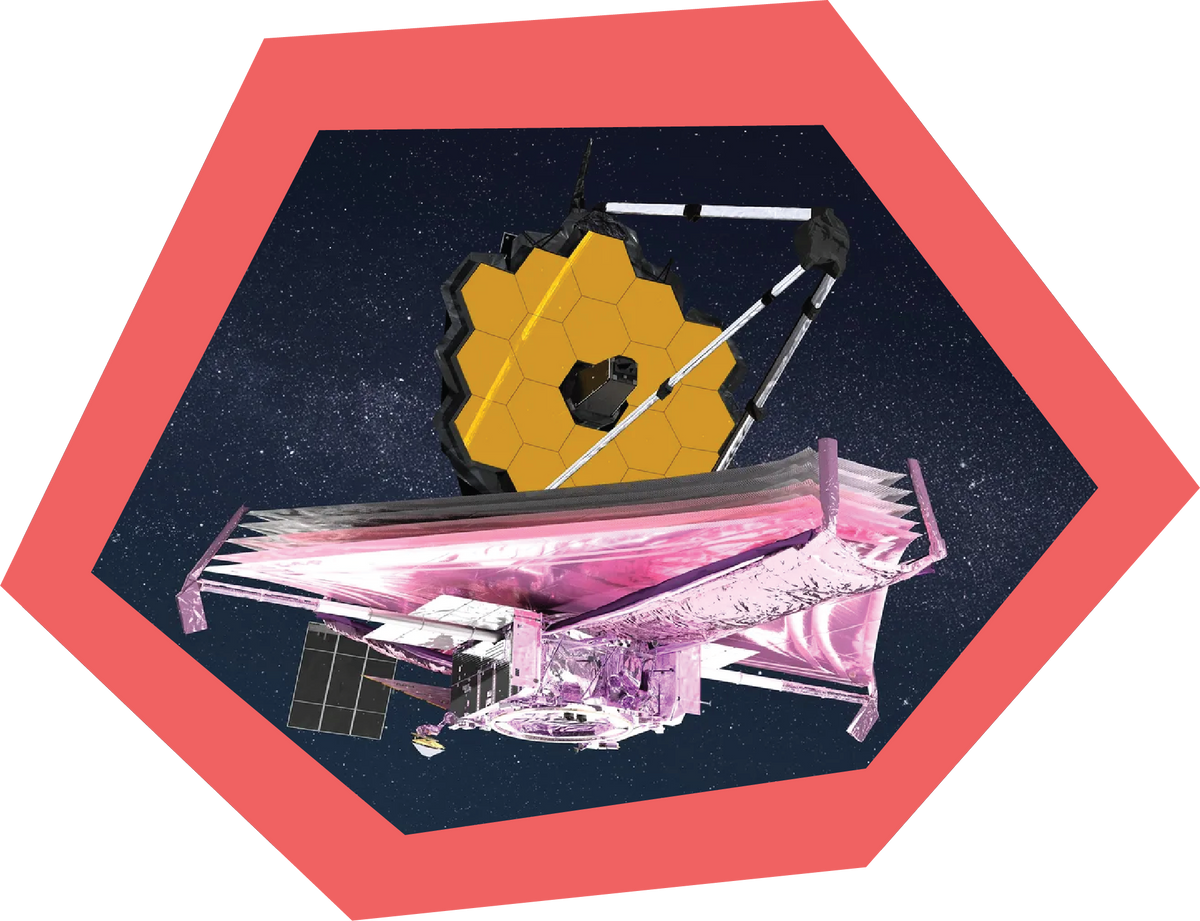
JWST Deployed in Space
JWST unfolded in space over 30 days: sunshield, mirror, and instruments
Fully deployed in January 2022 and now orbiting in deep space, JWST peers back over 13 billion years
It can see exoplanets, stellar nurseries, and even the birth of galaxies
It's the most advanced space observatory ever created
Fully deployed in January 2022 and now orbiting in deep space, JWST peers back over 13 billion years
It can see exoplanets, stellar nurseries, and even the birth of galaxies
It's the most advanced space observatory ever created

Deep Space in Detail: Cosmic Birthplaces
Webb reveals the unseen: baby stars, forming planets, and ancient galaxies
It captures details invisible to the human eye using infrared light
Every image is a time machine, peering into the earliest chapters of the universe
It captures details invisible to the human eye using infrared light
Every image is a time machine, peering into the earliest chapters of the universe


Translation missing: en.sections.mission.shop_the_mission
-
James Webb Space Telescope Hawaiian Shirt
Regular price $30.99 USDRegular price$54.99 USDSale price $30.99 USDSale

JWST: Built to See the Beginning of Time
- JWST's mirror spans 21.3 feet — almost 3x wider than Hubble's
- It unfolds in space like origami, with over 300 single points of failure
- The five-layer sunshield keeps instruments colder than -370°F
- Over 100 engineers and scientists designed the mirror
JWST Assembled
- 18 hexagonal beryllium mirror segments coated in vaporized gold
- Built to detect the faintest infrared light from ancient galaxies
- JWST has 344 single points of failure — every one had to work perfectly
- Decades in the making, but built to last far beyond
Launch Day: Destination Deep Space
- Launched atop an Ariane 5 rocket on December 25, 2021
- Engineered through a collaboration between NASA, ESA, and CSA
- Traveled nearly 1 million miles to L2, a gravity-stable orbit beyond the Moon
JWST Deployed in Space
- JWST unfolded in space over 30 days: sunshield, mirror, and instruments
- Fully deployed in January 2022 and now orbiting in deep space, JWST peers back over 13 billion years
- It can see exoplanets, stellar nurseries, and even the birth of galaxies
- It's the most advanced space observatory ever created
Deep Space in Detail: Cosmic Birthplaces
- Webb reveals the unseen: baby stars, forming planets, and ancient galaxies
- It captures details invisible to the human eye using infrared light
- Every image is a time machine, peering into the earliest chapters of the universe
Gold mirrors, interstellar light, and a mission powered by wonder — celebrate our boldest leap into the unknown.