
Apollo
COLLECTION
ApolloCOLLECTION

Browse by mission, era, or program

Apollo Lunar Module

The machine behind the mission

Apollo Lunar Module

  • 1969–1972
  • 6 Moon landings
  • Built to fly only in space

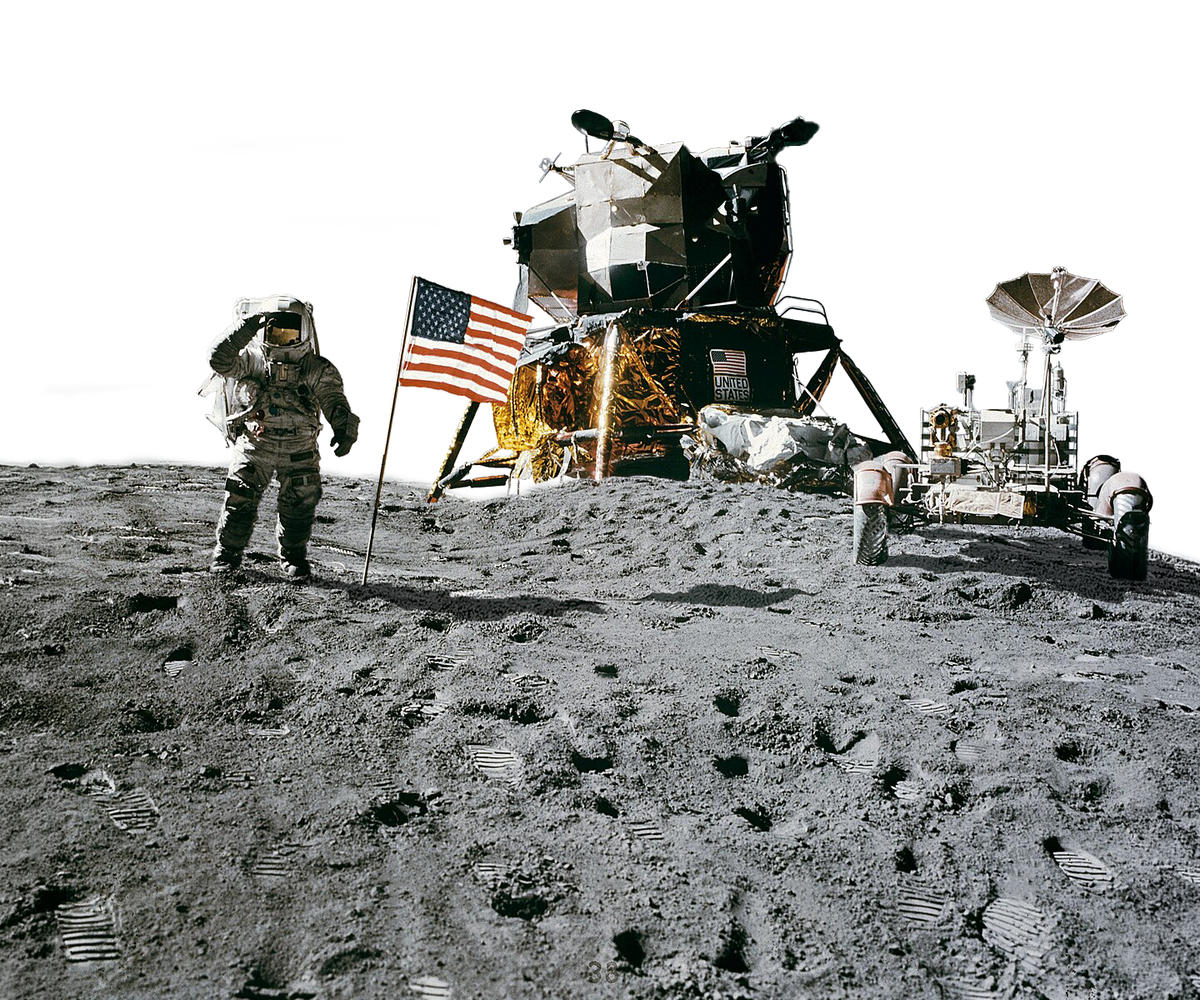
Two stages, walls as thin as a few sheets of foil, and no need to ever fly through air. The Lunar Module was built for one job — landing on the Moon — and it carried twelve people down to the surface and back up again.

Shop the Apollo & Skylab shirts

THE APOLLO LEGACY

From 1961 to 1972, the Apollo program represented humanity's boldest endeavor. Twelve astronauts walked on the lunar surface, forever changing our perspective of what's possible.

THE APOLLO LEGACY

Our Apollo collection captures the spirit of innovation, courage, and scientific achievement that defined this era. Each piece tells a story of human determination and the pursuit of the impossible.

SHOP Apollo & Skylab COLLECTION

SHOWING 4 OUT OF 4 PRODUCTS
Apollo 11 Final Flight Plan - July 1969

Apollo, by the numbers

Page 3-47MSC - FLIGHT PLANNING
Lunar orbit insertion
75:54:28LOI IGNITION - BEHIND THE MOON

Six minutes of engine, behind the Moon and out of radio contact, to drop into a 59 by 170 mile orbit.

Lunar orbit insertion

Figure 1-5MSC - FLIGHT PLANNING
Communications
3 RADIOSMOON TO EARTH

One voice from the surface went VHF to the Lunar Module, then S-band a quarter of a million miles home.

Communications

Figure 3-55aMSC - FLIGHT PLANNING
Rest attitude
10 HRSREST PERIOD - LUNAR ORBIT

Even sleep had an attitude: the docked ships were parked at a fixed angle to the Sun so nothing froze or cooked.

Rest attitude

DID YOU KNOW?
APOLLO 11

FLIGHT PLAN

AS-506 / CSM-107 / LM-5
FINAL - JULY 1, 1969

The book the crew flew by. Every hour of the mission, finalized two weeks before launch by the Flight Planning Branch at the Manned Spacecraft Center. The drawings in these pages are the real figures from it.

PREPARED BY
FLIGHT PLANNING BRANCH
FLIGHT CREW SUPPORT DIVISION
REPRINTED FOR CAPE KENNEDY CLOTHING
Artie RedstoneChief, Flight Planning Branch
Max QChief, Flight Crew Support Division
Turn the page →
MCC-H

Page 3-18TRANSLUNAR COAST

NOTES
TRANSLUNAR COAST
Tap the drawing to enlarge

A quiet hour on the way out. Star sightings with the sextant, a state vector uplinked from the ground, a maneuver pad to copy down. The inset is what the crew could see out the window - the whole Earth inside a four-degree field of view.

  1. 1Star sightings - the sextant is pointed at catalogued stars to check the platform alignment.
  2. 2Uplink CMC - Houston loads the computer by radio with where the ship is and where it is going.
  3. 3Earth at GET 26:00 - small enough to fit in a 4 degree field of view.
  4. 4MSFN bar - solid line, the network has the ship the whole hour.
This hour
GET25:00 - 26:00
Day2 / TLC
FOV4 deg
Sightings3

Source: Apollo 11 Final Flight Plan, NASA MSC, July 1, 1969.

MissionAPOLLO 11
EditionFINAL
DateJULY 1, 1969
Time25:00 - 26:00
Day/Rev4/1
Page3-18
MSC Form 29 (May 69)FLIGHT PLANNING BRANCH
MCC-H

DID YOU KNOW?FLIGHT PLAN

NOTES

Mission Duration

Apollo 11 took 8 days, 3 hours, and 18 minutes from launch to splashdown.

Splashdown, July 24, 1969, 12:50 pm EDT

A Station From a Spare

Skylab, America's first space station, was built inside a leftover Saturn S-IVB stage — roomy enough for its crews to jog laps around the walls.

Skylab - a Saturn S-IVB stage, fitted out

Mission Patches

Each Apollo crew designed their own mission patch, creating iconic symbols of space exploration.

Patch design was a crew privilege
MissionAPOLLO 11
EditionFINAL
DateJULY 1, 1969
Time
Day/Rev4/1
Page3-1
MSC Form 29 (May 69)FLIGHT PLANNING BRANCH
MCC-H

Page 3-47LUNAR ORBIT INSERTION

NOTES
LUNAR ORBIT INSERTION
Tap the drawing to enlarge

The hour before the burn that put Apollo 11 into orbit around the Moon. Read it the way the crew did: time runs down the left, the MSFN bar shows when Houston could hear them, and the boxed numbers are the burn itself - fired behind the Moon, out of contact with Earth.

  1. 1MSFN bar - the ground has the ship until 75:46. After that the Moon is in the way.
  2. 2GO / NO GO - every console in Mission Control polled before the crew is cleared.
  3. 3LOI-1 box - the event mark. Everything on this page leads to it.
  4. 4The burn: 5 min 58.9 sec, 2924.1 ft/s, into a 59.2 x 169.8 nautical mile orbit.
  5. 5The attitude sketch - how the stack is pointed for the burn, engine forward.
LOI-1 burn
GETI75:54:28
Burn time5:58.9
Delta V2924.1 fps
Orbit59.2 x 169.8 nm
Ullagenone

Source: Apollo 11 Final Flight Plan, NASA MSC, July 1, 1969.

MissionAPOLLO 11
EditionFINAL
DateJULY 1, 1969
Time75:00 - 76:00
Day/Rev4/1
Page3-47
MSC Form 29 (May 69)FLIGHT PLANNING BRANCH
MCC-H

Figure 3-52aLANDMARK TRACKING PROFILE

NOTES
LANDMARK TRACKING PROFILE
Tap the drawing to enlarge

How a crew fixed its own position from lunar orbit. The Command Module Pilot put a known crater in the sextant and took five marks as the spacecraft pitched slowly nose-down to keep it in view. Each mark told the computer where the ship really was.

  1. 1AOS - acquisition. The CSM/LM comes over the horizon pitched 2 deg down and begins pitching 0.3 deg per second to hold the landmark.
  2. 2Mark No. 3 - the middle of five sextant marks, taken looking straight down at the landmark.
  3. 3The landmark - a catalogued crater. Five marks on it and the navigation state vector is corrected.
  4. 4LOS - loss of sight. From first look to last is about three minutes.
  5. 5Center of the Moon. The orbit and the 1,080-mile lunar radius are drawn to scale.
Mark spacing
Delta T1300 sec
Delta T240 sec
Delta T325 sec
Delta T425 sec
AOS to LOS3 min

Source: Apollo 11 Final Flight Plan, NASA MSC, July 1, 1969.

MissionAPOLLO 11
EditionFINAL
DateJULY 1, 1969
TimeLUNAR ORBIT
Day/Rev4/1
Page3-52a
MSC Form 29 (May 69)FLIGHT PLANNING BRANCH
MCC-H

Section VISUMMARY FLIGHT PLAN

NOTES

Every crewed flight of the Apollo program and the Saturn-launched missions that followed it. Durations are days and hours.

FlightDateCrewDurationEvent
Apollo 7 11 - 22 Oct 1968 Schirra / Eisele / Cunningham 10d 20h First crewed Apollo; 163 orbits of Earth; the first live TV from a U.S. spacecraft
Apollo 8 21 - 27 Dec 1968 Borman / Lovell / Anders 6d 03h First humans to leave Earth orbit; ten orbits of the Moon; Earthrise
Apollo 9 3 - 13 Mar 1969 McDivitt / Scott / Schweickart 10d 01h First flight of the Lunar Module, in Earth orbit
Apollo 10 18 - 26 May 1969 Stafford / Young / Cernan 8d 00h Dress rehearsal - the LM flew to within 50,000 ft of the Moon
Apollo 11 16 - 24 Jul 1969 Armstrong / Collins / Aldrin 8d 03h First landing - Sea of Tranquility, July 20, 1969
Apollo 12 14 - 24 Nov 1969 Conrad / Gordon / Bean 10d 04h Pinpoint landing beside Surveyor 3; struck by lightning twice on ascent
Apollo 13 11 - 17 Apr 1970 Lovell / Swigert / Haise 5d 22h Oxygen tank explosion; the LM as lifeboat; the successful failure
Apollo 14 31 Jan - 9 Feb 1971 Shepard / Roosa / Mitchell 9d 00h Fra Mauro; Shepard, 47, hit two golf balls
Apollo 15 26 Jul - 7 Aug 1971 Scott / Worden / Irwin 12d 07h Hadley Rille; first Lunar Roving Vehicle; the Genesis Rock
Apollo 16 16 - 27 Apr 1972 Young / Mattingly / Duke 11d 01h Descartes highlands; the first landing in the lunar highlands
Apollo 17 7 - 19 Dec 1972 Cernan / Evans / Schmitt 12d 13h Last landing; Schmitt the first geologist on the Moon; night launch
Skylab 2 25 May - 22 Jun 1973 Conrad / Kerwin / Weitz 28d Rescued the station - sunshade and the stuck solar wing
Skylab 3 28 Jul - 25 Sep 1973 Bean / Garriott / Lousma 59d Two spiders, Arabella and Anita, spun webs in orbit
Skylab 4 16 Nov 1973 - 8 Feb 1974 Carr / Gibson / Pogue 84d Longest American flight until the Shuttle-Mir era
ASTP 15 - 24 Jul 1975 Stafford / Brand / Slayton 9d 01h Docked with Soyuz 19 - the last Apollo, the first handshake in orbit

Apollo 1 (AS-204) never flew: Grissom, White and Chaffee died in the pad fire of January 27, 1967. Skylab flew three crews to a station built from a Saturn S-IVB stage.

MissionAPOLLO 11
EditionFINAL
DateJULY 1, 1969
Time1968 - 1975
Day/Rev4/1
Page6-1
MSC Form 29 (May 69)FLIGHT PLANNING BRANCH
MCC-H

Figure 3-55aLUNAR ORBIT REST PERIOD ATTITUDE

NOTES
LUNAR ORBIT REST PERIOD ATTITUDE
Tap the drawing to enlarge

Even sleep had an attitude. In lunar orbit the docked spacecraft were parked so the sun struck them at a fixed angle, the high-gain antenna could still see Earth, and the cabin stayed at a temperature a crew could rest in.

  1. 1Sun line - theta is 150 degrees off the spacecraft X-axis so the hull heats evenly.
  2. 2Lunar Module docked nose-to-nose; the whole stack is flown as one vehicle.
  3. 3LOS Earth - the line to Earth, held so the antenna keeps the link to Houston through the rest period.
  4. 4Daylight and shadow on the Moon below. Shaded area is the night side.
Attitude
Theta150 deg
Phi100 deg
Subsolar pt60 deg
Rest period10 hrs

Source: Apollo 11 Final Flight Plan, NASA MSC, July 1, 1969.

MissionAPOLLO 11
EditionFINAL
DateJULY 1, 1969
TimeREST
Day/Rev4/1
Page3-55a
MSC Form 29 (May 69)FLIGHT PLANNING BRANCH
MCC-H

Figure 1-5LUNAR EXPLORATION COMMUNICATIONS

NOTES
LUNAR EXPLORATION COMMUNICATIONS
Tap the drawing to enlarge

One voice from the Moon to Earth went through three radios. The crewman on the surface talked VHF to the Lunar Module, the LM relayed on S-band to the tracking network, and the network put it on the loop in Houston - and on television.

  1. 1Command Module in orbit overhead - its own S-band link, two frequencies, ranging and voice.
  2. 2Lunar Module on the surface - the relay station for the man outside.
  3. 3EVA crewman - VHF only. 296.8 MHz voice, 259.7 MHz suit data.
  4. 4MSFN - the Manned Space Flight Network. Big dishes at Goldstone, Madrid and Honeysuckle Creek.
Frequencies
CSM up2106.4 MHz
CSM down2287.5 MHz
LM up2101.8 MHz
LM down2282.5 MHz
VHF A296.8 MHz
VHF B259.7 MHz

Source: Apollo 11 Final Flight Plan, NASA MSC, July 1, 1969.

MissionAPOLLO 11
EditionFINAL
DateJULY 1, 1969
TimeEVA
Day/Rev4/1
Page1-23
MSC Form 29 (May 69)FLIGHT PLANNING BRANCH
MCC-H

Section IVLUNAR SURFACE EVA

NOTES

Section IV - EVA preparation and egress, Apollo 11, July 20 - 21, 1969

Tick each item as you read it. Times are Ground Elapsed Time; Neil Armstrong reached the surface at 109:24:15.

Tap a box to check it off

Items complete 0/8GO FOR EVA
MissionAPOLLO 11
EditionFINAL
DateJULY 1, 1969
Time109:07 - 111:39
Day/Rev4/1
Page4-10
MSC Form 29 (May 69)FLIGHT PLANNING BRANCH
MCC-H

Section IABBREVIATIONS

NOTES
CSMCommand and Service Module - Columbia, the ship that went home
LMLunar Module - Eagle, the ship that landed
S-IVBThird stage of the Saturn V; it fired twice, the second time for TLI
TLITranslunar Injection - the burn that left Earth orbit, at 02:44:26
LOILunar Orbit Insertion - the burn behind the Moon, at 75:54:28
PDIPowered Descent Initiation - the start of the landing burn
DSKYDisplay and keyboard - the face of the Apollo Guidance Computer
P52Program 52 - realigning the guidance platform on the stars
PTCPassive Thermal Control - the slow roll on the way out and back
MESAModularized Equipment Stowage Assembly - the fold-down pallet on the LM leg
PLSSPortable Life Support System - the backpack
ASTPApollo-Soyuz Test Project, 1975 - the last Apollo flight
MissionAPOLLO 11
EditionFINAL
DateJULY 1, 1969
Time-
Day/Rev4/1
Page1-3
MSC Form 29 (May 69)FLIGHT PLANNING BRANCH